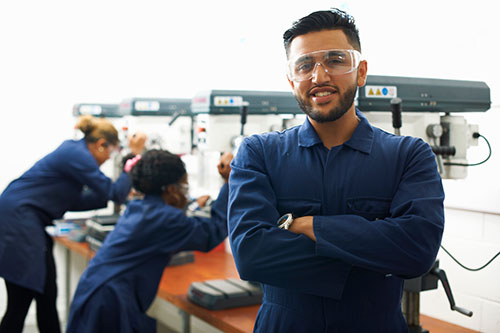
Schools, colleges and universities around the world increasingly source their lab equipment directly from China. The reasons are straightforward: comparable quality at 30 to 60 percent of European or American prices, deeper product range, and the ability to consolidate a complete school lab order with a single manufacturer. But getting the buying process right takes care — especially for institutions buying internationally for the first time.
This guide walks through the complete process of buying school lab equipment from China, including realistic school equipments with price benchmarks, quality evaluation, shipping options, and the traps that catch inexperienced buyers chasing the cheapest deal.
Why Schools Buy Lab Equipment from China
China has become the world's largest exporter of educational lab equipment for several reasons. The country's manufacturing base produces the entire supply chain in-house: glassware factories in Sichuan, optical component plants in Zhejiang, electronics suppliers in Guangdong, metalworking in Hebei. This vertical integration produces cost advantages that pure-resale markets cannot match.
For schools, the practical benefit is that the same Chinese factory often supplies educational scientific instruments, school laboratory scientific equipment and biology lab kits within a single order — eliminating the coordination headaches of buying from multiple regional suppliers.
Realistic Pricing — What School Lab Equipment Actually Costs
Buyers searching for school equipments with price often encounter a wide range of quoted figures. The variability reflects three real factors: equipment grade (student vs. instructor vs. research grade), brand origin, and quantity. Below are realistic 2026 benchmarks for school lab equipment ex-factory in China, before shipping and duties.
Physics Lab Equipment
- Optical bench (1m, complete with accessories): USD 60 to 180
- Resistance box (decade type): USD 25 to 75
- Galvanometer (student grade): USD 15 to 50
- Digital multimeter (educational): USD 12 to 30
- Spring balance set (six pieces): USD 20 to 45
- Newton's rings apparatus: USD 80 to 200
- Photoelectric effect apparatus: USD 250 to 700
Chemistry Lab Equipment
- Borosilicate beaker set (50ml to 1000ml, six sizes): USD 18 to 50
- Volumetric flask set (Class A): USD 35 to 90
- Burette with stopcock (50ml): USD 8 to 25
- Bunsen burner (school grade): USD 6 to 18
- Digital pH meter: USD 40 to 150
- Analytical balance (0.0001g): USD 250 to 600
- Hot plate with magnetic stirrer: USD 60 to 180
Biology Lab Equipment
- Monocular compound microscope (student): USD 75 to 220
- Binocular compound microscope: USD 150 to 450
- Stereo (dissecting) microscope: USD 90 to 300
- Digital microscope with USB camera: USD 180 to 500
- Dissection kit (12 instruments): USD 8 to 25
- Human anatomy model (heart): USD 35 to 120
- Articulated skeleton (full size): USD 280 to 750
Complete Lab Packages
A complete school physics lab serving 30 students typically costs USD 8,000 to 18,000 ex-factory. A complete chemistry lab runs USD 10,000 to 22,000. A complete biology lab runs USD 6,000 to 15,000. A combined three-subject school science lab package (physics, chemistry, biology) commonly falls between USD 25,000 and 55,000, depending on equipment grade and curriculum scope.
"Headline prices are only one factor. Total cost of ownership over a 10-year teaching life depends more on durability, spare parts availability, and warranty performance than on the initial sticker price."
Should You Look for the Cheapest School Equipment Manufacturers China Has?
Buyers searching for cheap school equipments manufacturers China often end up disappointed. Genuinely cheap educational equipment is built down to a price — and a school that has to replace cracked beakers, dim microscopes or broken balances every two years ends up paying more than the school that bought quality from the start.
What you actually want is the lowest 10-year total cost of ownership: equipment + shipping + duties + spare parts + replacements + instructor frustration + lost teaching time. The school lab equipment that wins on this metric typically costs 25 to 50 percent more upfront than the cheapest available, and 25 to 60 percent less than the European-branded equivalent.
Reframe your search from "cheap" to "value-grade direct from manufacturer". The educational lab equipment manufacturers in China who serve the global mid-market consistently — not the cheapest, not the most expensive — are usually the right starting point.
Step-by-Step: How to Buy School Lab Equipment from China
Step 1: Build Your School Equipment List
Before contacting any supplier, prepare a structured equipment list with item names, quantities, key specifications, applicable standards, voltage requirements (110V or 220V), and any curriculum-specific notes (CBSE, IGCSE, IB, country-specific). Vague specifications produce vague quotations and disappointing equipment.
Step 2: Shortlist 3 to 5 Manufacturers
Use a combination of online searches, trade-show contacts, government tender databases and reference recommendations to compile a shortlist. Prefer companies that describe themselves as school science lab equipment manufacturer with their own factory, not pure trading companies. Many institutions also ask for the school lab equipments manufacturers China contact number directly so they can speak to a sales engineer rather than emailing a generic address.
Step 3: Send the Same RFQ to All Shortlisted Manufacturers
Identical Request-For-Quotation documents to each supplier produce comparable responses. Specify Incoterms (FOB / CIF / DAP), payment currency, required documentation, lead time expectations and warranty requirements.
Step 4: Evaluate Quotations Holistically
The cheapest quotation is rarely the best. Compare:
- Itemised pricing (not bundled)
- Stated brand origin and material specifications
- Lead time commitments
- Warranty terms (months and on-site vs. return-to-base)
- Spare parts policy (10-year availability commitment)
- Installation and training inclusions
- Documentation completeness (certifications, lab manuals)
- Quality of communication during the quotation process
Step 5: Verify the Manufacturer
Before committing, confirm the manufacturer is genuine. Request a virtual factory tour by video call, check business registration through Chinese government online databases, ask for two reference customers in your region and contact them directly, and review independent factory audit reports if available.
Step 6: Negotiate the Contract
Standard payment terms are 30% advance, 60% before shipment, 10% after installation — or similar phased structures. Avoid 100% upfront payment. The contract should include delivery date with penalty clauses for delays, Factory Acceptance Test (FAT) and Site Acceptance Test (SAT) procedures, and explicit dispute resolution language.
Step 7: Pre-Shipment Inspection
For orders above USD 20,000, third-party pre-shipment inspection through SGS, TUV, Bureau Veritas or Intertek typically costs 0.5 to 1 percent of order value. Inspectors verify the goods match specifications, are properly packed and ready for export. This is the last point at which problems can be caught economically.
Shipping School Lab Equipment from China
School lab equipment is generally shipped by sea freight in 20-foot or 40-foot containers. A complete school lab fits in roughly half a 20-foot container; a full three-subject lab fills a 20-foot container; a multi-school district order may fill multiple 40-foot containers.
Sea Freight Transit Times from China
- To Africa east coast: 25 to 35 days
- To Africa west coast: 35 to 45 days
- To Europe: 30 to 45 days
- To Latin America: 35 to 55 days
- To Southeast Asia: 7 to 15 days
- To Middle East: 18 to 30 days
- To India and South Asia: 12 to 25 days
Air Freight (Urgent Orders)
Air freight delivers in 5 to 10 days door-to-door but costs five to ten times sea freight. For school lab orders, air freight is rarely justified unless replacing equipment for a critical examination or inspection.
Customs & Duties
Most countries apply import duties to school lab equipment ranging from 0 to 30 percent of CIF value. Many countries offer educational duty exemptions if the equipment is destined for an accredited school, college or university — arrange these letters with your education ministry well in advance, since they typically take weeks to obtain.
Required Documentation
Standard export documentation includes commercial invoice, packing list, bill of lading, certificate of origin, conformance certificates, end-use letter, fumigation certificate (for wooden packaging) and import permits where required. A reputable Chinese manufacturer prepares all of this as standard.
Quality Verification Without Travelling to China
Most school procurement teams cannot afford to fly to China for factory visits. The good news is that quality verification can be done remotely with reasonable confidence:
- Live video factory tour — ask the supplier to walk you through the facility on a video call
- Sample order — place a small order for one or two key items first
- Third-party inspection — engage SGS, TUV or Bureau Veritas for pre-shipment inspection
- Independent audit reports — ask for SEDEX, BSCI, or ISO audit reports if you have CSR concerns
- Reference verification — speak to recent customers in your region
Common Mistakes Schools Make When Buying from China
- Choosing on price alone — the cheapest is almost never the best total value
- Skipping the contract — verbal commitments are unenforceable across borders
- Paying 100% upfront — you lose all leverage if anything goes wrong
- Not reading Incoterms carefully — "shipping included" can mean very different things
- Underestimating customs duties — can add 10 to 30 percent to landed cost
- Forgetting installation and training — equipment that nobody can operate is wasted
- Ignoring spare parts — the lab needs replacements for the next 10+ years
- Buying from a trading company thinking it's a manufacturer
The Total Cost Picture
For budgeting purposes, add roughly 25 to 35 percent to ex-factory price for landed cost in your country. This covers sea freight, marine insurance, port handling, customs duty, GST or VAT, and inland transport. So a USD 30,000 ex-factory school lab order typically lands at USD 37,500 to 40,500 fully delivered.
Conclusion
Buying school lab equipment from China is one of the highest-leverage decisions an institutional procurement team can make. Done right, it delivers world-class teaching infrastructure at a fraction of the cost of European or American alternatives. Done badly, it produces expensive disappointments that take years to recover from.
The difference between the two outcomes is process: structured equipment list, careful manufacturer vetting, comparable quotations, sensible contracts, third-party inspection on larger orders, and realistic expectations on cost and lead time. Get each step right and the rest takes care of itself.
Liquid International is one of the established school lab equipment manufacturers in China, supplying schools, colleges and universities in over 65 countries. We welcome detailed RFQs, virtual factory tours and reference checks — the same scrutiny we recommend in this guide.
Ready to get a price for your school lab project?
Send your school equipment list and we'll respond with a detailed itemised quotation, lead time, shipping estimate and recommended phasing — within 24 hours.
Get a Detailed Quotation