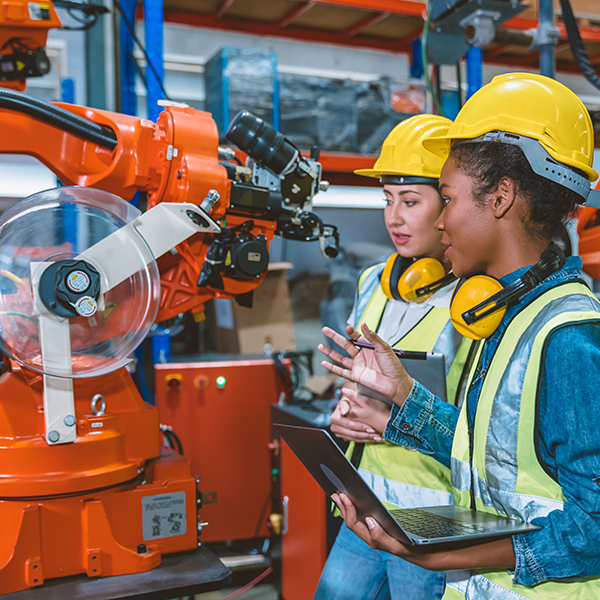
Mechatronics is the most fluid discipline in modern engineering. The skills needed in 2026 didn't exist a decade ago, and the tools have evolved alongside them. Robotics and mechatronics labs that were cutting-edge in 2018 are now visibly out of date. For institutions planning new labs or upgrades, understanding the trends shaping the field is essential to avoiding obsolescence.
Here are the seven trends we see reshaping robotics and mechatronics lab education right now.
1. Collaborative Robots (Cobots) Replacing Caged Industrial Arms
Traditional industrial robots required safety fencing, light curtains and restricted-access cells. Cobots — lightweight, force-limited robots designed to work alongside humans — have transformed both industry and education. They're safer, easier to programme, and reflect where industrial deployment is actually heading.
Modern mechatronics labs now combine one or two traditional 6-axis arms (for high-payload understanding) with multiple cobots that students can programme directly through hand-guidance and simple GUIs. Universities that haven't introduced cobots yet are training students for a workforce that no longer exists.
2. AI Vision and Machine Learning Integration
Industrial robotics has merged with computer vision and machine learning. Pick-and-place, defect detection, parts sorting and assembly verification are now AI-driven tasks. Lab kits are following: educational vision systems with pre-trained models, easy-to-train custom datasets, and integration with PLC and robot controllers.
"You can no longer teach robotics in 2026 without teaching computer vision. The two are inseparable in industry, and they should be inseparable in the lab."
Look for trainers that bundle a 2D or 3D camera, an edge AI accelerator (Nvidia Jetson, Coral TPU or similar), and pre-built workflows for common industrial vision tasks: barcode reading, dimensional measurement, defect detection, presence/absence verification.
3. IoT and Industry 4.0 Cells
The "smart factory" buzzword has resolved into something concrete: production cells equipped with industrial IoT sensors, edge gateways, MQTT messaging, OPC UA interoperability, and cloud-based dashboards. Mechatronics labs now include modular IoT-enabled cells where students learn protocol stacks, data engineering, predictive maintenance algorithms and cybersecurity.
The leading TVET ministries (Germany, Singapore, UAE) have made Industry 4.0 lab certification a requirement for funded programmes. Other countries are following.
4. Digital Twins and Simulation
Physical labs are expensive and student access is limited. Digital twins solve part of this problem: high-fidelity simulators that mirror real lab equipment, allowing students to programme and test offline before booking the physical equipment. Major industrial vendors (Siemens, FANUC, ABB, KUKA) now ship educational simulators alongside their hardware.
The best modern labs combine physical hardware with simulation seats at a 1:3 ratio: one trainer, three simulator stations. Students do their initial programming and debugging in simulation, then move to the trainer for final commissioning — replicating professional industrial workflow.
5. Modular Mechatronics Stations
Monolithic "smart factory" rigs have given way to modular systems where individual stations (distribution, processing, handling, sorting, storage) can be operated independently or coupled into a complete production line. This delivers two benefits: better student utilisation (six stations means six concurrent groups), and better pedagogy (a faulty station doesn't down the whole line).
Modularity also future-proofs the investment: you can add stations over time, replace individual ones with newer technology, or reconfigure for different curricula.
6. Open Architecture and Vendor Diversity
Mechatronics labs of the past often locked into a single vendor (typically Siemens or Festo). Modern programmes increasingly demand multi-vendor exposure: at least one Siemens PLC trainer, at least one Allen-Bradley, at least one Mitsubishi or Omron. Industry hires across the vendor ecosystem; education that produces single-vendor specialists limits graduate employability.
Open-architecture platforms (those that integrate with PROFINET, EtherNet/IP, Modbus TCP, OPC UA) are preferred over closed proprietary stacks.
7. Renewable Energy and Smart Grid Integration
Mechatronics is bleeding into renewable energy. Modern mechatronics labs increasingly include solar PV integration, battery management systems, micro-grid control, and EV charging station trainers. The skill convergence between mechatronics and energy is strong, and ministries funding skill development reflect that.
What This Means for Lab Planners
If you're planning a robotics and mechatronics lab in 2026, the modernisation roadmap should include:
- At least one cobot, ideally two, with vision integration
- One traditional 6-axis arm (for payload and industrial-realism teaching)
- PLC trainers from at least two major vendors (Siemens + Allen-Bradley or Mitsubishi)
- Modular mechatronics stations with IoT instrumentation
- Digital twin software seats (3:1 ratio with hardware)
- An AI vision teaching kit with edge accelerator
- An Industry 4.0 / IIoT module covering OPC UA, MQTT, cloud dashboards
- Renewable energy + EV charging integration trainers
Conclusion
The mechatronics labs that will look modern in 2030 are the ones being designed today around cobots, AI vision, IoT and digital twins. The labs being designed around 2015 patterns — caged arms, single-vendor PLC trainers, monolithic factory rigs — will look obsolete within five years.
If you're navigating these decisions, Liquid International's automation team can share lab layouts, vendor evaluations and equipment lists tailored to modern mechatronics curricula. We've helped polytechnics and engineering universities in 65+ countries build labs that don't just meet today's standards, but anticipate tomorrow's.
Need help with your lab project?
Our engineering team has helped institutions in 65+ countries plan, equip and commission engineering, scientific and TVET laboratories. We'd be glad to discuss your project.
Talk to Our Team